Incantations - 3,371 Arcane Design Patterns Across 146 Languages & Latent Space Constructs
A deep dive into incantations.tekromancy.com and the open-source Grimoire: exploring 3,371 design patterns implemented across 146 languages—from Whitespace and Malbolge to Lean, Rust, and AI prompt architectures.
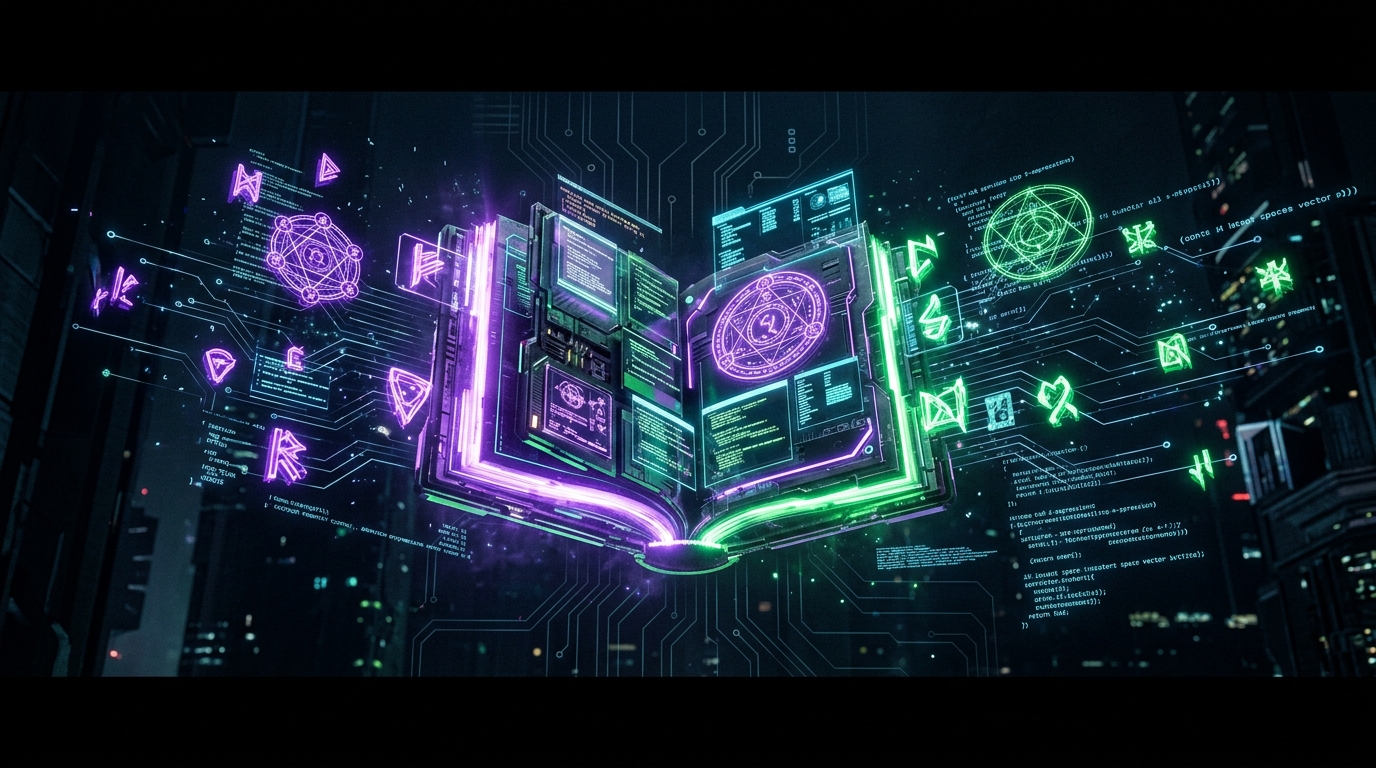
In 1994, the Gang of Four (Erich Gamma, Richard Helm, Ralph Johnson, and John Vlissides) published Design Patterns: Elements of Reusable Object-Oriented Software. For three decades, those 23 classical patterns—Singletons, Factories, Observers, Facades, Proxies, and Visitors—served as the lingua franca of commercial software engineering. Yet they were almost exclusively framed through the lens of early object-oriented languages like C++, Smalltalk, and later Java.
What happens when you liberate those patterns from the confines of classic object-orientation? What does an Abstract Factory look like in Whitespace, where syntax consists purely of spaces, tabs, and linefeeds? How does a State pattern manifest in Trefunge, where the instruction pointer navigates a three-dimensional vector space? How does a Memento translate into Lean or Coq as a formal mathematical proof, or into Generative AI as a Chain-of-Verification hallucination shield?
Following our initial dispatch on Tekromancy—Unveiling Incantations: Arcane Design Patterns and Latent Space Constructs—we are pulling back the curtain on the complete interactive compendium at incantations.tekromancy.com and the underlying open-source repository at github.com/Tekromancy/incantations.
Here is the full statistical breakdown, architectural philosophy, and deep-dive into the largest polyglot grimoire of design patterns ever assembled.
The Anatomy of the Grimoire: By the Numbers
When we launched the interactive matrix at incantations.tekromancy.com, our goal was to systematically capture how architectural intent survives across drastically different execution environments.
Here is the exact census of the matrix today:
| Metric | Count | Description |
|---|---|---|
| Total Incantations | 3,371 | Individual code patterns, shell spells, and prompt architectures |
| Unique Languages & Dialects | 146 | Spanning 7 decades of computing history |
| Core Pattern Families | 56 | The 23 canonical GoF patterns + modern resilience & neural patterns |
| Unique Domain Tags | 988 | Semantic markers for memory models, paradigms, and runtime targets |
| Pattern Categories | 5 | Behavioral, Structural, Creational, Architectural, and Resilience |
                       ┌───────────────────────────────┐
                       │   3,371 TOTAL INCANTATIONS    │
                       └──────────────┬────────────────┘
                                      │
         ┌──────────────────┬─────────┴────────┬──────────────────┐
         ▼                  ▼                  ▼                  ▼
   1,608 Behavioral   1,021 Structural   728 Creational   14 Arch/Resilience
       (47.7%)            (30.3%)           (21.6%)            (0.4%)
Category Breakdown
- Behavioral (1,608 Incantations / 47.7%): Algorithms, event assignment, state management, and command delegation implemented across functional pipelines, stack machines, and esoteric registers.
- Structural (1,021 Incantations / 30.3%): Adapters, bridges, decorators, facades, and proxies proving that composition over inheritance holds true even in languages without classes.
- Creational (728 Incantations / 21.6%): Object creation and resource allocation decoupled from runtime representation—from memory heaps to stack frames and compile-time macros.
- Architectural & Resilience (14 Incantations / 0.4%): Critical real-world primitives including stream cleavers, in-place POSIX file transmutations, and prompt-level verification rings.
The 146 Language Compendium
The 146 languages cataloged in Incantations do not just demonstrate syntax; they illustrate how different computational models interpret the same underlying logic.
                               THE POLYGLOT CONTINUUM

   Ancient & Mainframe       Esoteric & Spatial       Functional & Provable        Systems & AI
  [ALGOL, COBOL, JCL] ───► [Befunge, Whitespace] ───► [Lean, Agda, Haskell] ───► [Rust, Mojo, Prompts]
1. Esoteric & Spatial Enigmas (The Weird & Eldritch)
- Whitespace, Befunge, Trefunge, Brainfuck, Malbolge, Piet, INTERCAL, Chef, ArnoldC, Chicken, LOLCODE, GolfScript, Twine
- The Challenge: Creational and structural patterns require indirection. In languages like Whitespace (where syntax is invisible) or Befunge/Trefunge (where code is a multi-dimensional torus or cube), building a dynamic Dispatcher or Abstract Factory requires treating the instruction pointer's spatial trajectory as state. In Piet, an execution flow is encoded into color transitions across bitmap pixels.
2. Pioneers, Mainframes & Ancient Runes
- ALGOL, Fortran, COBOL, PL/I, RPG, JCL, MUMPS, Simula, B, BCPL, Assembly, Pascal, Forth, CHILL, SNOBOL
- The Legacy: Simula invented object orientation; ALGOL structured block scope. Incantations maps out how early procedural pioneers achieved polymorphism through raw function pointers, record tables, and batch job pipelines long before modern compilers introduced syntactic sugar.
3. Enterprise Titans & Legacy Workhorses
- ABAP, Delphi, ActionScript, ColdFusion, FoxPro, Visual Basic, VBA, C#, Rexx
- The Business Engine: ABAP (Advanced Business Application Programming) drives global enterprise supply chains. Seeing an Abstract Factory or Proxy implemented using SAP enterprise transaction boundaries shows how software architecture translates into multi-billion-dollar business workflows.
4. Formal Verification & Pure Functional Sorcery
- Lean, Coq, Agda, Isabelle, F, Idris, Haskell, OCaml, Standard ML (SML), Koka, Unison, Gleam, Roc, Clojure, Elixir, Erlang, Racket, Scheme, Common Lisp, PureScript*
- Mathematical Invariants: In interactive theorem provers like Lean, Coq, and Agda, a design pattern is not a design heuristic—it is a type-theoretic proof. A Singleton is a proof that the type is inhabited by exactly one element; a Builder is a dependent type enforcing compile-time validation.
5. Sovereign Systems & Modern Languages
- Rust, Zig, Go, D, Nim, Hare, Odin, Carbon, Mojo, V, Crystal, C, C++
- Zero-Cost Abstractions: Modern systems languages enforce compile-time invariants without garbage collection. In Rust and Zig, creational and structural patterns leverage compile-time metaprogramming (
comptime), affine type systems, and borrow checker semantics to ensure zero runtime penalty.
6. Decentralized & Provable Compute (Smart Contracts)
- Solidity, Vyper, Move, Cairo, Plutus, Michelson
- Deterministic Execution: On immutable blockchains, reentrancy vulnerabilities and gas constraints reshape design patterns. Proxies become upgradeable contract relays; State machines become strictly transition-verified financial locks.
7. Latent Space Constructs & AI Prompt Engineering
- Structured Prompts, Chain-of-Verification (CoVe), Archetype Projections
- The Probabilistic Frontier: In modern AI architectures, prompts are programs compiled into latent space. When building autonomous agents, classical patterns like Chain of Responsibility and Memento become structural prompt scaffolding designed to prevent hallucinations and maintain state.
Top 10 Most Conjured Design Patterns
Across all 146 languages, certain patterns emerged as universally applicable across different paradigms:
  Pattern Name        Count   Primary Domain
  ────────────────────────────────────────────────────────
  1. Facade            98     Structural / API Boundary
  2. Prototype         94     Creational / Cloning
  3. Template Method   94     Behavioral / Algorithm Skeletons
  4. Singleton         91     Creational / Shared State
  5. Memento           90     Behavioral / State Snapshots
  6. Builder           88     Creational / Stepwise Construction
  7. State             86     Behavioral / State Transitions
  8. Adapter           85     Structural / Interface Bridging
  9. Bridge            85     Structural / Decoupled Abstraction
 10. Decorator         85     Structural / Dynamic Augmentation
Why Facade leads the pack (98 implementations): Regardless of whether you are writing ABAP, SML, or a Bash script, systems inevitably become complex. The Facade pattern represents the fundamental human impulse to hide terrifying underlying machinery behind a clean, elegant doorway.
Expounding on the Unveiling: Three Key Architectural Highlights
In our previous article, Unveiling Incantations, we touched briefly on the transition from classical GoF to generative AI. Let's examine three specific incantations that demonstrate the scope of this project:
1. The Chain of Verification (CoVe) Hallucination Shield
In traditional software, a validation pipeline verifies user input before writing to disk. In Large Language Models (LLMs), stochastic token prediction frequently introduces confident hallucinations.
The Chain-of-Verification prompt pattern in Incantations forces an LLM into an internal loop of recursive self-inquiry before emitting a final payload:
- Baseline Generation: Draft the initial analytical response.
- Verification Question Formulation: Identify factual assertions and generate verification queries targeting potential inconsistencies.
- Execution & Fact-Checking: Answer the verification questions independently without bias from the baseline response.
- Consolidated Synthesis: Emit the final verified artifact with hallucinated tokens pruned.
       [USER PROMPT]
             │
             ▼
     ┌───────────────┐
     │ Baseline Gen  │
     └───────┬───────┘
             │
             ▼
     ┌───────────────┐
     │ Question Plan ├──────────┐
     └───────┬───────┘          │
             │                  ▼
             │         ┌─────────────────┐
             │         │ Isolated Fact   │
             │         │ Verification    │
             │         └────────┬────────┘
             ▼                  │
     ┌────────────────┐         │
     │ Final Verified │◄────────┘
     │ Output Payload │
     └────────────────┘
This transforms raw generative inference into a deterministic Behavioral Pattern that can be reliably embedded in autonomous agent swarms.
2. Spatial Creational Patterns: Whitespace & Trefunge
In standard languages, creating an object involves allocating a block on the heap and returning a pointer.
In Whitespace, there are no letters or numbers—only space (ASCII 32), tab (ASCII 9), and linefeed (ASCII 10). The Abstract Factory incantation sets up an Input-Output/Stack manipulation protocol where consecutive tabs and spaces construct a dispatch table on the call stack, enabling the runtime to dynamically swap algorithmic families without a single printable character.
In Trefunge, the execution environment exists as a 3D grid ($x, y, z$). The creational pattern uses directional vectors (<, >, ^, v, h, l) to steer the instruction pointer through spatial coordinate cubes that allocate different structural subroutines depending on which plane the program enters.
3. The Stream Cleaver: In-Place Config Transmutation
Born from deep POSIX philosophy, the Stream Cleaver is an architectural shell pattern for high-uptime Linux systems.
When updating live configuration files in production without breaking file descriptors or introducing race conditions, naive file writes can cause read corruption. The Stream Cleaver combines atomic inode replacement with streaming filter pipelines (sed, awk, sponge, and memory-mapped buffers) to achieve zero-downtime hot mutations across active system configs.
Exploring the Live Matrix
The companion web application at incantations.tekromancy.com is built for fast, frictionless exploration:
- Instant Search & Filter: Filter instantly across all 3,371 patterns by language, category, or GoF pattern name.
- One-Click Formulas: Every card contains a syntax-highlighted code formula (
data-formula) that can be copied directly into your editor or shell. - Cyberdeck Telemetry HUD: Features live client telemetry, FPS meters, and system encoding monitors styled after a futuristic systems terminal.
# Clone the complete grimoire to your local machine
git clone https://github.com/Tekromancy/incantations.git

# Enter the sanctum
cd incantations

# Explore the patterns
ls -la patterns/
The Evolution of Code as Magic
Whether you are configuring eBPF probes in modern C, wrestling with macro expansion in Common Lisp, verifying formal safety proofs in Lean, or tuning neural prompt weights for multi-agent workflows, software architecture remains a craft of structural harmony.
Design patterns are not rules etched in stone—they are recurring shapes in the geometry of thought.
- Explore the Live App: https://incantations.tekromancy.com
- Read the Unveiling on Tekromancy: https://tekromancy.com/blog/unveiling-incantations/
- Contribute to the Grimoire: https://github.com/Tekromancy/incantations